Tag Archive for: Fiber

WASHINGTON, April 29, 2025 – A new USDA National Hemp Report shows a 40% increase in the value of industrial hemp production, which now totals $445 million for 2024.

“The growth we are seeing in the industrial hemp sector is a clear indication of its expanding role in the U.S. economy,” said NIHC President & CEO Patrick Atagi. “We’re seeing remarkable strides in hemp production across all sectors—floral, grain, fiber and seed—and are excited for what the future holds as more innovations come to the forefront. With sustained interest and new market opportunities, we believe the hemp industry will continue to thrive and create jobs, while contributing to sustainable solutions for various industries.”

Key highlights from the USDA’s National Hemp Report for 2024 include:

  • Overall value of hemp production: $445 million, up 40% from 2023.
  • Floral hemp: A dramatic 159% increase in production, with 20.8 million pounds of floral hemp produced.
  • Fiber hemp: Continued expansion, with 60.4 million pounds harvested, representing a 23% increase.
  • Seed hemp: Exceptional growth, with the value of seed production increasing by 482%, reaching $16.9 million.
  • Area harvested for fiber: 18,855 acres, up 56% from 2023, showing strong demand for sustainable materials.

These findings underscore the growing adoption of hemp as a versatile and sustainable resource, with expanding applications in textiles, construction, and bio-plastics.

“We are at a critical juncture, where industry leaders, farmers and innovators are coming together to unlock the full potential of hemp,” Atagi added. “As the market for hemp in industrial products continues to evolve, NIHC remains committed to supporting this growth through policy advocacy, education, and global trade efforts.”

The NIHC looks forward to building on this momentum and working with stakeholders across the hemp supply chain to strengthen the industry and ensure its sustainable future.

Dear Chairwoman Stabenow and Ranking Member Boozman:

On behalf of our members nationwide, the National Industrial Hemp Council of America (NIHC) offers its recommendations, enclosed with this letter, for incorporation in the 2023 Farm Bill toward ensuring the viability and global competitiveness of U.S. domestic hemp production. The 2018 Farm Bill re-legalized the production of hemp, and before that, the 2014 Farm Bill authorized its research, but these new authorities have fallen short in enabling hemp to develop as a commodity at a significant scale. As Congress takes up our nation’s next Farm Bill, the time has come to apply the many lessons learned over the past decade and resolve these shortcomings.

Few if any crops have ever presented such a wide range of uses as hemp. Integral to human civilizations for millennia, and with countless innovative applications emerging at a dizzying pace, hemp produces high-protein foods and feeds from its seeds; wide-ranging industrial applications from its stalks, including textiles, paper, bioplastics, building materials, renewable energy, and advanced composites; and wellness products in high demand by consumers worldwide. Grown at scale, hemp offers an unparalleled opportunity for climate-smart agriculture, resilient rural economies, and increased domestic self-reliance in food security and manufacturing. But despite the best efforts by regulators and industry stakeholders, shortcomings in Federal law continue to squander these opportunities and portend hemp’s demise as a U.S. commodity if not resolved in the next Farm Bill. NIHC’s recommendations are aimed at avoiding such an outcome.

NIHC is the hemp industry’s DC-based trade association. We serve our members and the industry at large by integrating our industry’s expanding expertise with senior-level agricultural policy practice to deliver credible analysis and coordination on the full range of legislative, budgetary and regulatory matters impacting the hemp value chain. Headed by former USDA executives, senior Hill staffers and agricultural trade association leaders, we focus on building capacity for farmers, businesses, regulators and consumers across all segments of the hemp industry, to fulfill hemp’s promise as a keystone of American agriculture and as a driver of opportunity for all.

The 2018 Farm Bill re-legalized the production of hemp, and before that the 2014 Farm Bill authorized its research, but these new authorities have fallen short in enabling hemp to develop as a commodity at significant scale. As Congress takes up our nation’s next Farm Bill, the time has come to apply the many lessons learned over the past decade and resolve these shortcomings. Few if any crops have ever presented such a wide range of uses as hemp. Integral to human civilizations for millennia, and with countless innovative applications emerging at a dizzying pace, hemp produces high protein foods and feeds from its seeds; wide-ranging industrial applications from its stalks, including textiles, paper, bioplastics, building materials, renewable energy, and advanced composites; and wellness products in high demand by consumers worldwide. Grown at scale, hemp offers unparalleled opportunity for climate-smart agriculture, resilient rural economies, and increased domestic self-reliance in food security and manufacturing.

But despite the best efforts by regulators and industry stakeholders, shortcomings in Federal law continue to squander these opportunities and portend hemp’s demise as a U.S. commodity if not resolved in the next Farm Bill. With that decade of lessons in mind, and with the goal of unfettering this new yet ancient crop to fulfill its promise for American agriculture, the National Industrial Hemp Council offers the following recommendations for inclusion in the next Farm Bill:

1. FIT-FOR-PURPOSE COMPLIANCE TESTING.

  • Dual hemp licensing: Differentiate “Industrial” (fiber and grain) from “Horticultural” (flower).
  • Test products at point of transfer/sale: Consistent USDA controls on lawful transfer of hemp.
  • Performance-based sampling for “Industrial,” pre-harvest testing for “Horticultural:”. Visual inspection of “Industrial” and statistically valid pre-harvest testing of “Horticultural.”
  • Adopt the NASDA-recommended threshold of 1% total concentration of all tetrahydrocannabinols, to relieve farmers of undue risk and avoid false findings of non-compliance.
  • Permanently remove requirements for DEA certification of hemp testing labs.

2. EQUITY AND OPPORTUNITY FOR ALL IN DOMESTIC HEMP PRODUCTION.

  • Eliminate background checks and remove felon ban for hemp farming.
  • Prohibit the re-criminalization of hemp.
  • Designate hemp seed and hempseed by-products as feed for non-consumption animals.
  • Enact “Safe Banking” for hemp.

3. NORMALIZE HEMP IN USDA RESEARCH AND SUPPORT PROGRAMS.

  • Permanently dual-designate hemp as both specialty and commodity crop depending on the purpose for which it is grown.
  • Direct USDA to include hemp in all subsidy and grant opportunities for which other commodity and specialty crops qualify, including research programs.
  • Permanently authorize hemp as eligible feedstock for renewable energy research and support.
  • Ensure USDA has access to adequate funding to administer hemp production in all 50 states;
  • Increase USDA FAS MAP and FMD funding to increase promotion of US hemp exports.
  • Establish and fund US Hemp Fiber Standards and Quality Act to create an ARS hemp structure and research center similar to the Cotton Structure and Quality Research Unit in New Orleans.
  • Authorize and fund a properly staffed, USDA-led inter-departmental hemp working group and FACA committee that includes multiple agencies and a cross-section of hemp industry stakeholders.

1. FIT-FOR-PURPOSE COMPLIANCE TESTING.

One of the greatest hindrances to hemp production in the United States is the protocol for THC compliance testing. Though hemp has been produced overwhelmingly throughout its multi-millennial history for products of its seeds (grain) and stalks (fiber), which are biologically incapable of producing THC or any other cannabinoid, U.S. law currently requires THC testing of all hemp crops, including those grown for fiber and grain, but does not require testing of hemp products. This is the case even though THC levels can fluctuate slightly in all hemp crops due to conditions beyond farmers’ control, whereas finished products can be specially formulated in a controlled setting to contain specified amounts of THC and synthetic analogs. Thus, the current approach to hemp compliance testing carries undue risk to farmers, which has a chilling effect on farmer adoption and investment (particularly in fiber and grain), while having little bearing on the amount of THC in products entering the hemp market. Ideally, hemp should be treated like any other agricultural commodity and not subjected to compliance testing of crops in the field, but rather tested and certified as needed when the resulting products enter commerce, just like dairy, meat and cotton.

Nevertheless, NIHC recognizes that hemp, as a type of cannabis, elicits a range of stakeholder concerns that are heightened by its cultivation–especially horticultural cultivation of hemp for CBD production, which is difficult to distinguish from cultivation of marijuana. For this reason we propose to differentiate testing of crops grown for fiber and grain (“Industrial Hemp”) from testing of crops grown for flower and their cannabinoids (“Horticultural Hemp”), while establishing meaningful protocols for testing of hemp products upon entering commerce:

A. Fit-for-purpose hemp licensing – Differentiate “Industrial Hemp” (fiber and grain production) and “Horticultural Hemp” (flower/cannabinoid-only production):

Direct USDA to develop regulations for issuing two license types nationwide; states can opt out of dual licensing and authorize only one or the other. Industrial Hemp: fiber and grain crops and products thereof, grown only outdoors (broadacre); USDA to define quantitative criteria, such as plant density, in rulemaking. Horticultural Hemp: flower crops, nursery stock and products thereof. Any hemp crop not meeting Industrial Hemp criteria is Horticultural Hemp. Include a research sub-license type for companies that are developing and producing seeds for replanting purposes.

B. Fit-for-purpose testing of hemp products at point of transfer/sale:

Direct USDA to develop regulations for consistent nationwide controls on lawful transfer of hemp products: ‘Industrial Hemp License:’ (verifying that crop is from licensed producer) must accompany all transfers regardless of type—industrial or horticultural. ‘USDA-Compliant Hemp Certificate:’ (establishing THC compliance, similar to how USDA certifies dairy, meat, etc.) must accompany all transfers containing flower or flower derivatives, regardless of license type—industrial or horticultural. ‘USDA Hemp Processor License:’ must accompany in-process flower derivatives (concentrates) that exceed the Federal threshold for THC in hemp; not for retail sale, and lawful for possession and transfer only by holders of the USDA Hemp Processor License.

C. Fit-for-purpose performance-based sampling and testing of hemp crops.

Direct USDA to apply statistically valid testing of horticultural hemp crops to ensure against illicit marijuana production, and to apply its existing performance-based sampling authority nationally for industrial hemp crops: Performance-Based Sampling for Industrial Hemp crops: Direct USDA to apply its existing authority for performance-based sampling nationwide, with visual inspection criteria for Industrial Hemp Pre-Harvest Sampling and Testing for Horticultural Hemp crops: Direct USDA to update its existing pre-harvest sampling and testing regulations to ensure that compliance determinations are made based on statistically valid confidence intervals (margins of error) for estimated THC levels, accounting for in-field sampling variance as well as laboratory measurement uncertainty. Performance-Based Sampling Option for Horticultural Hemp crops: Direct USDA to standardize it existing authority for performance-based sampling as an available alternative to pre-harvest sampling and testing for horticultural licensees based on 3 prior years of compliant tests, and for immature nursery stock. Fund research to determine potential applicability of variety/seed certifications for use in performance-based sampling.

D. Adopt the NASDA-recommended threshold of 1% total concentration of all tetrahydrocannabinols.

To relieve farmers of undue risk and avoid false findings of non-compliance. Another major factor causing compliance testing to be a hindrance is the definition of hemp as provided in the 2018 Farm Bill, which is based on a 0.3% delta-9 THC threshold for compliance. The originators of this 0.3% figure explicitly acknowledged it as arbitrary in the peer-reviewed scientific literature where it first appeared (Small and Cronquist, 1976), and reiterated this acknowledgment in public statements in 2021 while further recommending 1% as a more appropriate threshold. The current definition also does nothing to limit the entry into the hemp market of products containing other intoxicating tetrahydrocannabinols besides delta-9. Finally, the natural range of variation of hemp plants in the field makes it problematic at best to determine non-compliance with statistical validity at such a minuscule quantity. If challenged in court, the overwhelming majority of non-compliance determinations made under the existing definition would likely not meet the minimal burden of proof for sanctioning private property as required by the Administrative Procedures Act. To rectify these problems, NIHC supports the resolution adopted by the National Association of State Departments of Agriculture, by a 45-3 vote, to revise the definition as follows: The term “hemp” means the plant Cannabis sativa L. and any part of that plant, including the seeds thereof and all derivatives, extracts, cannabinoids, isomers, acids, salts, and salts of isomers, whether growing or not, with a total tetrahydrocannabinol concentration of not more than one (1) percent on a dry weight basis.

E. Permanently remove requirements for DEA certification of hemp testing labs.

Since promulgating its regulations implementing 2018 Farm Bill direction for domestic hemp production, which includes this provision, USDA has wisely exercised its administrative discretion to suspend this requirement every year, lest it hobble the industry for lack of sufficient DEA-certified laboratory capacity around the country. Labs with USDA-approved accreditations, which can be found in greater abundance around the country and also newly established at lower cost, can be relied upon to provide adequate verification of THC levels for determining compliance. Congress should thus eliminate the DEA certification requirement in favor of this approach.

2. EQUITY AND OPPORTUNITY FOR ALL IN DOMESTIC HEMP PRODUCTION.

A. Eliminate background checks and remove felon ban for hemp farming. No other agricultural commodity requires such a policy, which most impacts rural and underserved communities, reinstitutionalizes the racial injustices of the War on Drugs, and harkens to the long history of racial discrimination in American agriculture that USDA and the nation at large still struggles to overcome. Such restrictions should not be permitted in Federal or State law. Furthermore, farming is a productive pathway for people convicted of felonies to re-engage in their communities. No correlation has been shown to indicate that former felons are any likelier to commit crimes in connection with hemp farming than in connection with farming of any other crop.

B. Prohibit the re-criminalization of hemp. As with the discriminatory undertones of banning felons and requiring background checks for hemp licensing, numerous efforts are underway at the state level that portend to restrict interstate commerce in Federally lawful hemp and hemp products, and in some cases even to outlaw their possession. While States have the prerogative to regulate sales that take place within their borders, current law prohibits States and Tribes from impeding the transport of Federally lawful hemp in interstate commerce, and this should be amended to prohibit impeding the possession of Federally lawful hemp as well. Otherwise, injustices that remain prevalent in narcotics enforcement may extend into a substance whose legality is fully ensconced in Federal law.

C. Designate hemp seed and hempseed by-products as animal feed for pets, specialty and exotic pets, and horses. Just like other commodity crops that serve the protein and oil feed markets, hemp seed based ingredients should be excluded from the 1958 Food Additive Petition requirements. The exclusion should be limited to ingredients that are: sourced from only from hemp seed harvested from Federally compliant crops; are for non-consumption species (companion, exotic, equine, and any other non-consumption animals); possess no added cannabinoids; and comply with existing animal feed manufacturing processes, labeling requirements, and product registrations. Additionally, timelines for applications to the FDA’s Center for Veterinary Medicine (CVM) should be shortened: FDA responses should be required within 60 days of submitting initial and each subsequent response, and final decisions should be required within a maximum of two years. Budgetary support should be granted to the FDA-CVM to meet these obligations.

D. Enact “Safe Banking” for hemp. Amid fitful efforts to normalize banking for cannabis businesses despite the continuing prohibition of marijuana under Federal law, the hemp industry—especially small businesses and enterprises in rural and underserved communities—continues to suffer from the same lack of access to banking, advertising, and other essential business services. Despite the Federally legal status of the products they sell, hemp businesses are forced to pay onerous fees for these essential services; if indeed they can even access them at all. Payment processors, lenders, investors, media outlets and other service providers need to know that they are protected against the possibility of sanctions for serving businesses that engage in hemp commerce; no other agricultural commodity faces such difficulties and the Farm Bill is an appropriate vehicle to rectify this problem.

3. NORMALIZE HEMP IN USDA RESEARCH AND SUPPORT PROGRAMS.

  • Make permanent Congress’s FY22 budget direction to USDA to dual-designate hemp as both specialty and commodity crop depending on the purpose for which it is grown.
  • Direct USDA to include hemp in subsidy and grant opportunities for which other commodity and specialty crops qualify, including research programs.
  • Permanently authorize hemp as an eligible feedstock for renewable energy research and support.
  • Ensure USDA has access to adequate funding to administer hemp production in all 50 states in the event more States terminate their hemp programs (in favor of USDA’s improved hemp regulations).
  • Increase USDA FAS MAP and FMD funding to increase promotion of US hemp exports in order for the Market Access Program and Foreign Market Development Program to more adequately promote the global competitiveness of U.S. hemp.
  • Establish and fund US Hemp Fiber Standards and Quality Act to create a USDA ARS hemp structure and research center similar to the current USDA-ARS Cotton Structure and Quality Research Unit in New Orleans,
  • Authorize and fund a properly staffed, USDA-led inter-departmental hemp working group and FACA committee that includes multiple agencies, departments and a representative cross-section of hemp industry stakeholders, chartered to advise on rulemaking, regulatory implementation, support programs and trade issues within USDA and other Departments.

##

The National Industrial Hemp Council of America provides high-quality networking and resources for its members, from farm to consumer. Its leadership is composed of leading international, federal, state, private industry, and government professionals throughout the sector. The organization is dedicated to furthering market development, assisting members in entering the industry, and educating consumers on industrial hemp and its applications. For more information, please go to www.nihcoa.com.
Products Added to the Oregon Guide List for Pesticides and Cannabis

The guide list was updated August 3, 2021. The intent of the list is to assist growers in distinguishing those pesticide products whose labels do not legally prohibit use on cannabis (hemp and marijuana) from those that clearly do not allow use. The list is not an endorsement or recommendation to use these products in the production of cannabis or hemp in Oregon.

You can view the guidance from the Oregon Department of Agriculture here.

The Congressional Research Service Produces Long-Awaited Report on Hemp

The Congressional Research Service (CRS)serves as non-partisan subject matter experts on a number of things and advises Congress on the technical details on a variety of issues. From trade to foreign affairs to internet data, there is no shortage of technical expertise from CRS on industries that Congress regulates.

Working at the direction of Congress, CRS advises members and staff as they work through legislative issues. The hemp industry is no different and there are a variety of opinions on Capitol Hill and the regulatory agencies about how to solve the current and emerging issues facing our industry. Because hemp was legalized through the 2018 Farm Bill – which in terms of Congressional timelines is recent – there hasn’t been a lot of technical expertise being offered to members of Congress – the exception really being the meetings NIHC staff has conducted on Capitol Hill.

We were excited to see the report from the CRS finally come out this week on the hemp industry and offer some technical details on all of the industrial uses for the plant for lawmakers making policy decisions that have both short and long-term consequences for our members and the industry writ large.

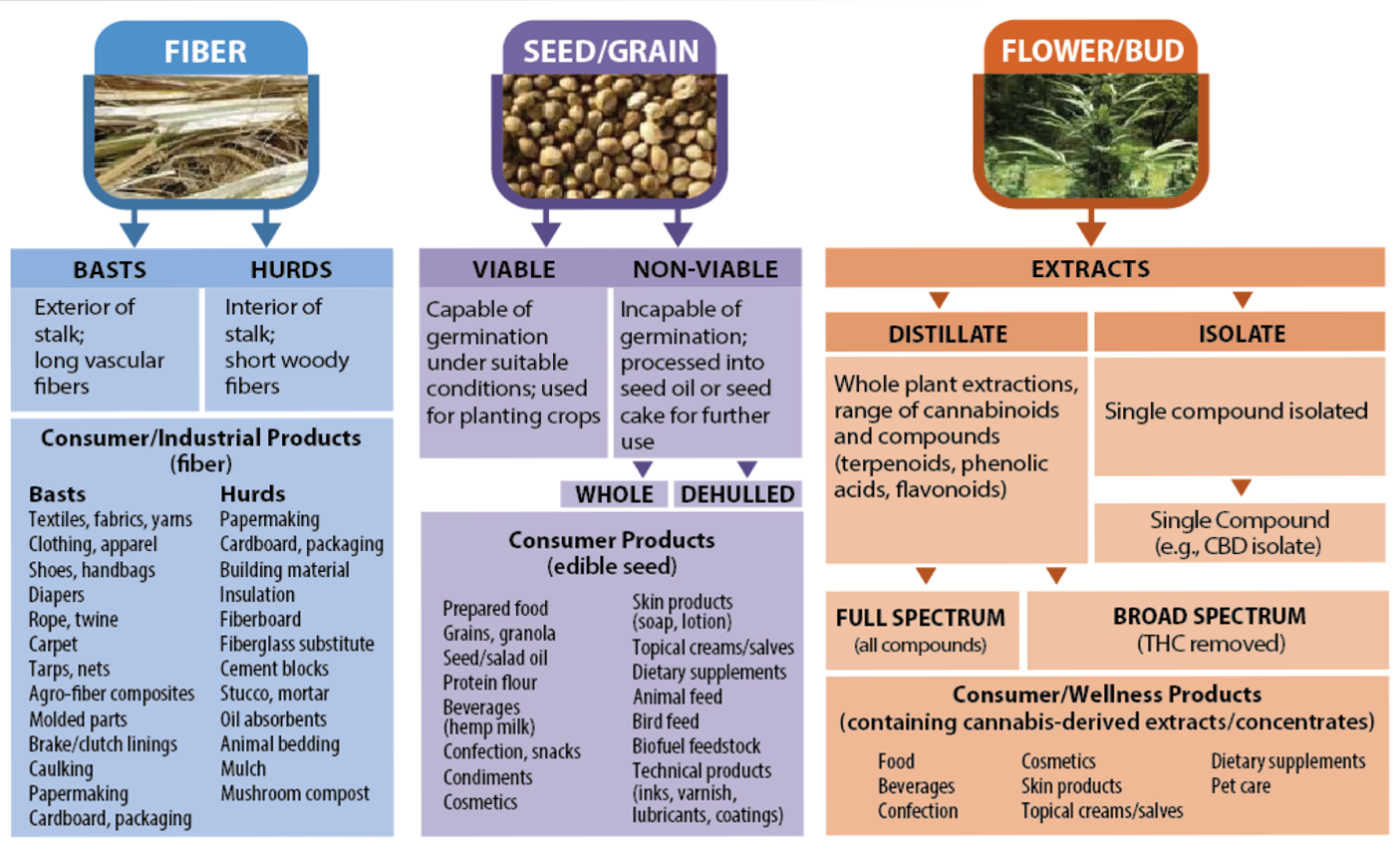
The CRS report centered around three things, fiber, seed/grain and the flower and you can see the graphic below that summarizes the report:

(Source: CRS Report to Congress: “Production, Marketing, and Regulation of Hemp Products, June 22, 2021, https://bit.ly/3zYbRon).

The report also gives a brief update on the current legislative efforts in Congress as they pertain to hemp, many of which the NIHC has provided significant impact on.

One detail to point out about the report, it mentions that hemp seeds are used as animal feed. That’s a huge win for CRS to put that on record in their report not just for the NIHC, but for our partners at the Hemp Feed Coalition, of which NIHC is a member.

This report may seem like a small step, but it’s a big win for our industry as a whole. Largely because of the work that NIHC is doing and the technical details we’ve been offering to lawmakers and their staff is now verified by the non-partisan technical experts at the Library of Congress.

The report is publicly available, and you can read it in full here.

Texas Hemp Growers Association Collaborates with Farmers on Hemp Production

The Texas Hemp Growers Association (THGA) has the mission to help leverage farmer influence on the emerging industrial hemp industry. They provide farmers with the resources they need to make decisions regarding the cultivation and marketing of hemp and hemp-derived products. THGA provides practical expertise for anyone wanting to grow industrial hemp, while also working diligently to ensure that the livelihood of farmers is at the forefront of all discussions regarding hemp in Texas.

“For years farmers have created commodity trade associations for marketing, policymaking, research, and education,” says Tillery Sims, THGA Executive Director. “If we are to see hemp become a true rotational crop option it will follow the path of those other commodities. That path will be created by farmers who have led the way for centuries in innovation and strategic agricultural development. Associations that create the space for farmers to develop the industry are invaluable.”

In addition to dedicating time and resources to things like policy, infrastructure, and communications, THGA is progressive in supporting ventures that promote inputs, production, processing, and manufacturing systems that will benefit growers for generations to come and build stability in the emerging hemp industry. They aim to develop markets for industrial hemp and create and operate cooperative marketing organizations. THGA is also committed to maintaining a positive public image of industrial hemp and sustain strong working relationships with law enforcement agencies.

Planting Success

Legislatively, THGA is actively working with Sen. Charles Perry ( R ) who currently chairs the Senate Committee on Water, Agriculture & Rural Affairs and Representative Tracy King (D-Batesville), who originally wrote 2019’s Bill 1325 which paved the way for Texas farmers to grow industrial hemp. Right now, the THGA is working with the legislators to clean up the original bill’s rules and reflect the new USDA guidelines.

“We are happy with our communications on how the hemp program works here in Texas and how the year went,” says THGA’s President Kyle Bingham of Bingham Organics and Bingham Family Vineyards. “The communication is open, and lawmakers are receptive to our ideas.”

“Traditionally, Texas farmers grow cotton,” says Bingham. “We like the potential of hemp as a rotational crop, planting and harvesting before cotton season.”

While Bingham’s business is Bingham Family Vineyards, where his multigenerational wine growing family produces 100% Texas grown and crafted estate wines, the fullest expression of the High Plains, they are first, farmers. Several years ago, they saw opportunity in growing hemp, in rotation with their seasonal cotton crops. From their Bingham Organics hemp brand, they currently sell organic tinctures, but have their eyes set on the industrial side of growing hemp.

“We entered the industry as a CBD supplement company,” says Bingham. “But we see in the future that CDB will become a by-product of the hemp fiber industry. I am really excited with the prospects of using the whole plant.” And focus on the plant itself is where Bingham and the THGA have had its core efforts.

THGA is close to 100 members, whom all currently farm anywhere between 2,000-15,000 acres of other commodity crops. They are focusing primarily on genetics in 2021 as an association. “We are not in a traditional hemp growing environment here in Texas,” notes Bingham. “Many regions need to be concerned with overwatering hemp, and we don’t have that problem here. Much of the established data doesn’t apply to us. So, we are continuing our 2020 plant trials with 14-15 different genetics.”

This year, THGA will be testing different stock from Czech Republic and Italy. They also want to do a second trial with Canadian fiber. It wasn’t successful the first time, so farmers will try earlier planting dates to see if it does better. “We take a micro and macro approach. We also have Texas Tech is partnering with us on producing small lots of detailed varieties and different planting techniques. We are all looking for data.”

Growing to Scale

Once the viable varieties are known, Bingham says the next hurdle is how to grow thousands of acres of it for industrial use in the future. “We have to figure out how to mechanize this crop as the demand for industrial hemp grows. We want to be ready to target large-scale customers.”

Texas farmers see much potential coming for industrial hemp. “I think we will see hemp replace single use plastics in the future. As we better understand the need for biodegradable hemp-based products, we can work with plastics companies to create more sustainable solutions. There are lab-produced prototypes that, when put in soil, break down in less than 6 months. The issue is, how do we mass produce the concept, and minimize the costs.”

While there are many obstacles to overcome, that is the future THGA and its members envision. “Once we prove all this can be done, it will be a matter of time before legislators mandate it, with California leading the way.” Costs right now are prohibitive, notes Bingham, for much of the innovation. But as they learn more and as legislation supports sustainable solutions that industrial hemp brings to the table, it will drive the hemp industry forward into mass production.

“I hope that people realize the CBD rush is over, and fiber is coming in a few years,” notes Bingham. “With that said, it is a hard couple years ahead. We have to learn every step of the process before we are ready to grow millions of acres. In Texas, we grow four million cotton acres a year. If we hemp into a third year rotation, it’s in our ballpark.”

“Industrial hemp can bring manufacturing back to small  town America, be a job maker. It is exciting to see.”

https://txhempgrowersassociation.com/ and
https://www.facebook.com/txhempgrowers/

An Interview with NIHC Board of Director Robert White

As in most farm bureaus, at the Indiana Farm Bureau (INFB), they have a vision to keep agriculture in Indiana strong and vibrant, to provide quality food to Indiana residents and to protect the rural life they love. They are the largest grassroots farm organization in the state with more than 250,000 members, and offices in all 92 counties. Started in 1919, INFB is well-positioned as the Voice of Indiana Farmers, and well-equipped to assist the farmer to leverage industrial hemp.

NIHC caught up with board member Robert (Bob) White, INFB’s Director of National Government Relations, to discuss the state’s progress with the crop and the outlook for the future. In his current role, White is responsible for keeping the Indiana Congressional Delegation abreast of INFB policy. In 2017, he was chosen to be on the AFBF farm bill working group whose task it was to help shape the possible outcomes of the current farm bill. It was the sixth farm bill that White has worked on.

NIHC hopes that more Farm Bureaus get involved in the organization to bring unity and cohesion to the hemp farming community. “Indiana Farm Bureau has been a great partner and can show how a collaboration with other state-based Farm Bureaus can help promote the hemp industry overall,” says Patrick Atagi, NIHC Board Chair.

Here are Bob White’s thoughts.

Early Adaptor

White saw potential for hemp farming early on and has worked to keep his finger on the pulse of the movement. “I met Patrick Atagi, NIHC Board Chair, at a USDA’s Agricultural Outlook Forum about 5 years ago, and he told me of his idea to launch the organization. We have been connected ever since. I came on as a board member early on,” says White. White believes hemp has a big future ahead, once regulatory challenges can be ironed out. While all that’s being accomplished, White wants farmers and other farm bureaus to work together to get knowledgeable on the nuances of growing the hemp plant.

Being in the heart of the country’s farmland, White and the INFB want to help bring the state into industrial hemp farming with success.

“Indiana farmers have been discussing industrial hemp for quite a while. We are always looking for diversification away from corn and soybean, especially when prices were in the dumps about 8 years ago. We began talking about it then in Indiana through our participation in the Midwest Hemp Council. One of our INFB members, Jamie Campbell Petty, is its Executive Director, and has been working on state legislation as well as the ’18 farm bill, all to support the growth of industrialized hemp here.”

“Being involved with NIHC has also been a great resource,” says White. “One of the benefits of belonging to an organization like NIHC is that you are on the inside track on what is happening,” says White. “NIHC has basically stood the test of time as an organization. It is dedicated and deeply invested to keep industry moving forward. It provides good and factual information sources instead of disinformation, which flows from everywhere right now.”

___

“There is a solitude about growing hemp that is attractive.”

___

Hemp Rising

The thirst for knowledge on growing industrial hemp is growing, and many different avenues of education are available. “Even land grant colleges are getting involved,” says White. “They are spreading the word to educate farmers, along with local community colleges near rural areas. People want to know how to grow it and what to do with it. At the last Midwest Hemp Council meeting, we had close to 500 attendees, and half were farmers within 8 states. And, there were some who have never farmed.”

White noted how people who are not farmers by trade are leaving longstanding careers to grow hemp, mostly for CDB. “Many people want to see the fruits of their labor at the end of the day, instead of work that sometimes can take 5-6 years to see results. There is a solitude about growing hemp that is attractive.”

The lack of education and experience has unfortunately led to some of the failures of the industry that any budding niche might experience. It has also led to some of the misinformation that is pervasive in the industry today. To combat this, White wants to see more people getting educated on agronomics of hemp.

Hemp Agronomics 101

While the industry looks attractive and has that instant gratification appeal, White notes it takes more time to develop a business than most have given it so far. “It takes a while to learn to grow it. Early on, it took special treatment for soy and corn, too. We learned and they grew as commodities. There is still a lot of agronomics on the growing, planting, harvesting and processing of hemp to learn,” says White.

Farmers who are agriculturally-motivated to do something different with their land have so far tested the waters and planted crops. But the missing piece is demand. “Strong demand is missing. It takes a lot of capital investment to set up a fiber processing facility, which our state of Indiana needs. We have not reached a critical mass, not at that tipping point. More people will get involved, and as we learn, we will do what we farmers always do – we will turn it into a commodity,” notes White.

He even predicts the industry early adopters will reap the most significant profits of the industry expansion. “Hemp is a finicky crop. Those who are working out the growing process now will be able to jump back in successfully when things start to heat up. They will be ready to bring a harvest to a supplier with efficiency. It is important that farmers figure this out now while we wait for demand to rise.”

Resolving Issues

Industry obstacles are currently on their way to being resolved, slowly but surely, White says. “Organizations like the NIHC are at the forefront of these practical, legal and consumer awareness hurdles, and there is a future for industrial hemp on the horizon.”

“Legally, I don’t get much involved on that front – only when we lobby for leeway in THC levels. Right now in Indiana, we see a lot of crops being destroyed as the go-to law enforcement directive. There are other ways to handle the crop where the farmer doesn’t lose their whole investment, such as taking it to a fiber processing plant, where they take a ding on the price, but can still sell it as fiber as opposed to CBD.”

Law enforcement in Indiana, like elsewhere in the nation, is asking for testing options. They want to be able to test it on the spot to determine a course of action. “There needs to be a better certification process, for sure, and a path for law enforcement that doesn’t lead to all loads being destroyed or buried.”

On the consumer front, White sees promise in NIHC’s Hemp Checkoff program. “I think we need a checkoff just like other commodities. Farmers do see valuable benefits to a checkoff; we just want to get the timing right to launch it. Soybean, corn, beef and milk have successfully educated people about the products, and farmers saw a return on their investment.”

In the short-term, White believes farmers need to focus on the agronomics of industrial hemp – the growing, harvesting, processing, and sale. “Farmers cannot grow it and hope someone will buy it, maybe like they have done with other crops,” White says. “Let demand grow, and then plant it. Then the marketplace will also work out the issues like THC, certification, transportation and more to accommodate the end uses.”

“I think in 3 to 5 years, this industry will come into its own for the farming community,” White concludes. “They should keep paying attention, learning, discover their market, be conservative until all that is determined. Only then they can grow 1,000 acres of it.”

Tag Archive for: Fiber

From the event website:

Vietnam’s newest textile event brings a new trade fair experience not seen before in Vietnam and the ASEAN region. 

  • The most comprehensive trade fair in the region: covering the full textile value chain from materials through production to end products.
  • Full spectrum of products on show in three sectors: apparel fabrics, yarns & fibres and garments; home & contract textiles; technical textiles, nonwovens and textile technologies.
  • An international showcase: exhibitors from 21 countries & regions and buyers from 54+ countries & regions in 2026.

Register now

National Industrial Hemp Council of America
Privacy Overview

This website uses cookies so that we can provide you with the best user experience possible. Cookie information is stored in your browser and performs functions such as recognising you when you return to our website and helping our team to understand which sections of the website you find most interesting and useful.